SquadOS vs Zendesk AI: Which Platform to Choose for AI Support
Zendesk AI is a copilot bolted onto a ticketing help desk. SquadOS is a full AI agent platform billed by usage. See the real difference before you pick one.
On this page
Zendesk is practically a synonym for help desk software. Any company that has set up a support operation has probably run into it: ticket queues, a knowledge base, canned macros for fast replies. Over the past few years Zendesk stacked AI on top of that: a copilot for the human agent and a bot that answers some questions before a ticket even opens.
The question is whether that solves the same problem an AI agent platform like SquadOS solves. Not quite. This article compares the two directly, so you do not pick the wrong tool for the size of the problem you actually have.
What each platform really is

Zendesk was built as a ticketing system. It is where support turns into a queue, a priority level, and an SLA. The AI layer (Zendesk AI) exists to help the human agent respond faster: suggesting replies, summarizing customer history, and in some plans letting a bot resolve the simplest questions before a human joins the conversation. AI is a boost layered on top of a ticket flow that already existed.
SquadOS was built as an AI platform for business, not a help desk. The core idea is different: employees chat with models inside an audited internal hub, internal agents automate entire processes, and external agents handle customer conversations end to end on WhatsApp, Telegram and your website, with governance built in from day one. There is no ticket queue underneath. There is an agent that understands the question, checks the knowledge base, and resolves it on the spot, escalating to a human only when it actually needs to.
The core difference: Zendesk AI speeds up people who already work inside a ticketing system. SquadOS removes a good chunk of the need for the ticket itself, because the agent resolves the conversation on its own.
Copilot for a human agent vs an agent that handles it alone
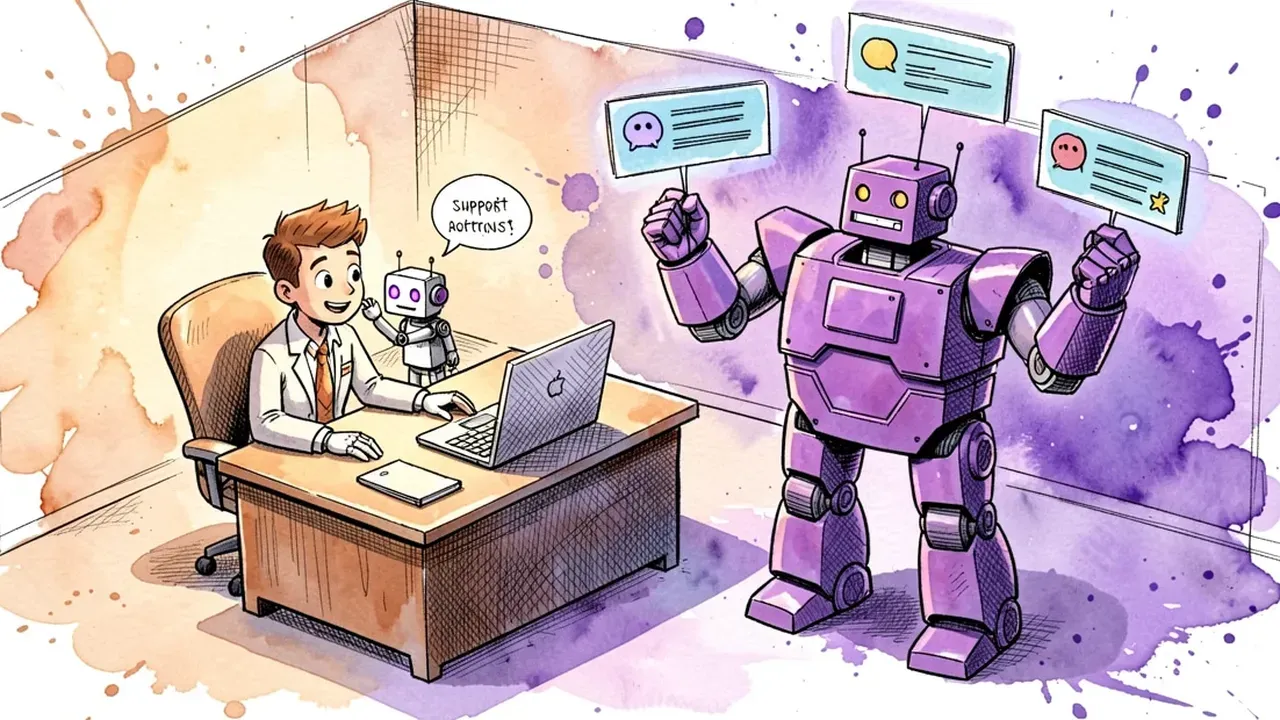
In the Zendesk model, the human team stays at the center of the operation. AI suggests replies, summarizes conversations, and cuts typing time, but someone on your team still reviews and sends most of the more complex answers. It is a productivity boost for a team that is already running.
In SquadOS, the external agent handles the conversation alone, 24 hours a day, without needing a human online for every reply. It carries the company’s knowledge base, understands questions in plain language (not just a filled-in form field), and decides on its own when to resolve and when to escalate to an actual human. That is automation of the support itself, not just a nudge for whoever already answers.
That changes which kind of operation each platform fits best:
- Zendesk AI shines for a company that already has a structured support team and wants that team responding faster, with less typing and more context on screen.
- SquadOS shines for a company that wants an AI agent covering the entire first line of support, freeing the human team for the cases that genuinely need judgment.
Plenty of operations do not pick just one: they use a SquadOS agent to resolve the bulk of recurring questions and keep the human team, copilot or not, for whatever is left.
Per-seat pricing vs pay-per-use

A traditional help desk charges per seat: every human agent who logs in is a paid license, so cost climbs with headcount, not with how much conversation actually gets resolved. That fits the Zendesk model naturally, because the product was built for people to use, not for AI to run on its own.
SquadOS charges for AI usage: credits consumed by the agent, not a seat per person. Users are unlimited on the paid plan. That matters because in an AI support operation, the bottleneck is not how many people have access to the dashboard, it is how much conversation volume the agent is actually resolving. Paying per seat for a product whose heavy lifting is done by AI, not by a logged-in human, is the wrong math.
On the governance side, SquadOS already ships with native guardrails against hallucination and personal data leaks, full audit trail on every conversation, and official WhatsApp, Telegram and website channels connected without manual integration work. The agent improves itself with AutoLearn: every question it fails to answer well becomes an improvement opportunity, detected automatically in the knowledge base, with no one manually hunting for gaps.
How to decide between the two

The right choice depends on where your support bottleneck actually is today, not on which brand is more familiar.
Zendesk makes sense when you already have a structured human support team, with defined ticket queues and SLAs, and you want that team working faster with AI help inside the flow you already have.
SquadOS makes sense when the goal is an AI agent actually resolving support, without depending on a human for every single reply, with pricing that tracks real usage instead of team size, and governance that ships ready on day one.
If the question is “I want an agent that handles my customer end to end on WhatsApp, Telegram and my website, that charges for what it actually resolves, and that brings audit trails without me building any of it,” the answer leans toward SquadOS. On SquadOS you build that agent in minutes with AgentMaker, connect it to the official channels, and let AutoLearn maintain the knowledge base on its own, all inside the same platform that also runs your internal hub and your internal agents.