AI for gyms and fitness studios: class booking and membership renewal on WhatsApp without burying the front desk
AI for gyms and fitness studios books classes, reminds members before renewal and cuts no-shows on WhatsApp, without pulling coaches off the floor.
On this page
Monday, 6am. The front desk hasn’t opened yet, but WhatsApp already has a dozen messages waiting: one member asking if there’s still a spot in the 7am spin class, another warning they can’t pay this week and asking to hold off on canceling, a third wanting to know if the personal trainer moved Thursday’s session. By the time staff walk in, they’ve already burned half an hour typing answers that were the same the day before, before the first member of the day even shows up.
Gyms and fitness studios run on recurrence: a class every week, a membership that renews every month, a member who drifts in and out of a workout routine all year long. That produces a high, repetitive message volume, very different from a business that sells once and moves on. Most of that volume doesn’t need a trained person typing it out, it needs a fast, correct answer, exactly the kind of task a well-configured AI agent on WhatsApp handles without pulling an instructor off the floor or the front desk away from the counter.
Why gym message volume behaves differently
A retail store sells and the customer disappears until the next purchase. A gym or studio lives on a member who keeps interacting: asking about class times, a question about the next installment, a heads-up they’ll miss today’s session, a request to switch groups. It’s continuous contact, not a one-off, and most of it repeats daily with small variations.
Add the vertical’s own calendar on top. Membership renews every month and members rarely remember on their own. Fixed-schedule classes pack out during peak hours (6 to 8pm at most gyms) and sit empty mid-morning, generating a constant stream of “is there a spot?” messages. Trainers and instructors swap shifts and go on vacation, and every change turns into a round of messages to every member in the group. It’s high volume, mostly predictable, mixed with exceptions that need human judgment in the moment: an injury, a health question, a contract negotiation.
The common mistake is trying to fix this by hiring more front-desk staff. The problem isn’t headcount, it’s that most of that headcount’s time goes into typing the same answer for the tenth time that day, instead of helping the member standing at the counter or the one about to cancel.
What an AI agent actually solves
The repetitive, low-judgment part of gym support is exactly where an AI agent on WhatsApp delivers fast value, without inventing a fitness assessment or promising a result it has no business promising:
Booking and confirming a spot in a group class, checking the actual class capacity and closing the reservation without a phone call. Automatic membership renewal reminders, with the option to renew or split payment right inside the chat, days before a lapsed payment turns into a collections problem. Instant answers to recurring questions: opening hours, plan pricing, whether today’s class got canceled, whether a guest pass is allowed. Rescheduling a one-on-one session or personal training slot the moment a member says they can’t make it, no phone call needed.
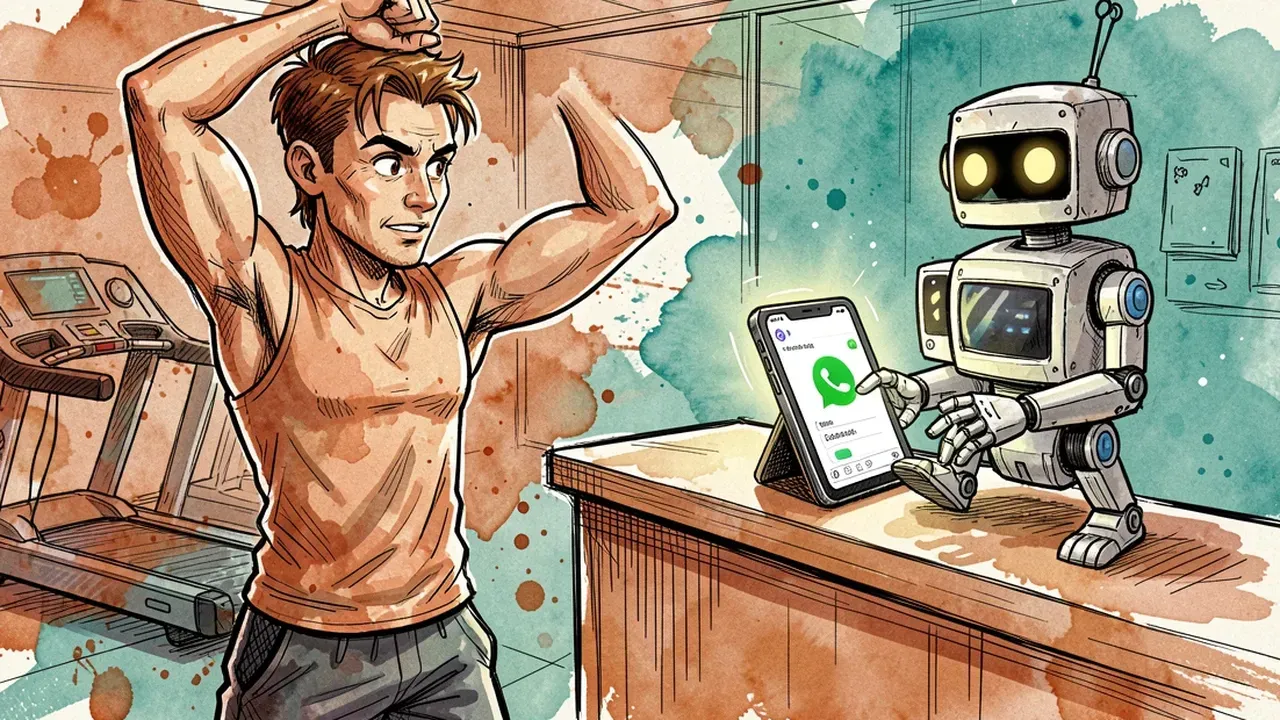
Each of those tasks today eats up minutes from staff who could be looking after members instead of managing a calendar. Picture a neighborhood gym with one front-desk person on the morning shift. If half the day’s messages are “is there a 7am spot today?” or “when’s my membership due?”, that person is spending the whole morning typing repeat answers instead of greeting whoever walks in to train or dealing with a member who’s unhappy. Taking that weight off the routine doesn’t cut headcount, it frees that person to do what only a human does well: welcome someone walking in for the first time, and pay attention to the member who’s about to quit.
Where AI hands off to a human
Pain, injury and health questions are not the moment for an agent to carry the conversation alone. A member reporting knee pain after a workout, a question about resuming training after surgery, or anything that sounds out of the ordinary: the agent recognizes the pattern and escalates to a human right away, instead of trying to give guidance it has no business giving. The same goes for off-menu contract negotiation and fitness assessments, which stay a trainer’s job.
The rule is simple: anything that’s scheduling, reminders or a frequently asked question, AI handles end to end. Anything involving the body, health or a negotiation outside the standard terms, it recognizes fast and routes to the right person.
Connecting to the gym management system already in place
No gym wants to switch management software just to get an AI agent. A useful agent plugs into the workflow that already exists: it checks the real class schedule and capacity in the gym’s management system, confirms payment status before promising a renewal, and updates the member’s record without a side spreadsheet. Without real integration into the software the gym already runs, the agent just becomes one more isolated channel promising a spot that might not even exist.
Turning this into an operation, not a one-off experiment
The real payoff shows up when the agent covers the hours the front desk doesn’t, weekends, holidays, before 6am, while following the same rules as the gym: plan pricing, cancellation policy, brand tone. That requires an agent configured with governance, not a loose chatbot promising a discount the gym never approved.

What to track after automating
Turning the agent on is the start of a tuning routine, not the end of the work. Three numbers tell most of the story: time to first response (it should drop to seconds), how many conversations the agent closes on its own without escalating, and the membership renewal rate after the automatic reminder kicks in. Together, those three quickly show whether the agent is genuinely taking weight off the front desk or just reformatting the same manual work.
It’s also worth reviewing, from time to time, the conversations the agent escalated when it didn’t need to, and the ones it tried to handle alone when it should have passed to a human. That’s how the team closes gaps in the knowledge base and tightens the rule, without rebuilding the agent from scratch.
Bring your gym or studio’s support to an agent that answers around the clock on WhatsApp, Telegram and your website, with guardrails that lock down exactly what it can and can’t promise. SquadOS builds that agent in a conversation, no prompt writing required, and keeps everything auditable from the first message.